The Art of Figuring it Out
By Jenna Scherma, Project Alpaca mentor and board member
The other day, I was talking to Catherine (our executive director) about the list of schools and organizations we were going to call to recruit Mentees for the 2027 cohort. I told her, I’ve never done cold calling in my life, but I was pretty sure I could figure out the motion if I just gave it a go.
She said to me, “This seems to be somewhere you thrive. Taking something you don’t know how to do, and just figuring it out.”
Honestly, it was one of the best compliments I’ve ever gotten!
Maybe that was something I learned to do after I incessantly watched the claymation version of “Santa Clause is Coming To Town,” when I was a child, where there’s an entire sequence around putting “one foot in front of the other.”
Maybe that was something I learned to embrace as a product manager working at startups where you’re tasked with trying to solve impossible problems all day long.
Or maybe it was something I learned from mentoring young people.
Project Alpaca always was able to bring in mentees that had a certain tenacity to them. Sometimes they were shy, unsure of themselves, but they were trying to build a path forward for themselves, and therefore decided they were going to put themselves out there and give it a go. Maybe it wasn’t fearlessness, but it was being brave enough to push through the fear.
And you could see it in the way they showed up week after week, whether it was training for mock interviews, drafting (and re-drafting) their resume, or working with a team of other Alpacees for the first time to solve a real problem they were seeing and experiencing in their communities.
They showed up, they tried something they didn’t quite know how to do yet, and they figured it out. Because it was through the effort of trying, that they learned how to do it.
This was especially prevalent in our recent partnership with Uptown & Boogie Healthy Project, a NYC-local program that had a team of young interns working together to create opportunities for low-income community residents in under-resourced areas to learn how to lead healthier lifestyles through food and fitness.
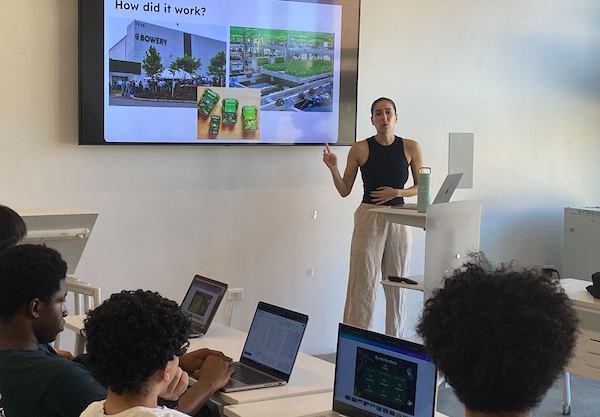
Catherine and I visited their office in Harlem, where I spoke about my short-lived experience working in Agriculture Technology at Bowery Farming, followed by working with the interns individually on each of their projects.
The interns had done everything from building new hydroponic irrigation systems for their greenhouse, to building drones that analyzed images of crops, to building an entirely new events platform, and re-designing and optimizing their existing vendor platform.
The young intern who had built the drone product told me that they had never flown a drone in their life and had no idea how computer vision worked before. The greenhouse team was problem-solving an irrigation problem they didn’t know how to solve, by ruling out different approaches one-by-one. And the tech teams had spent the summer working through the plethora of problems that user feedback had raised.
When I was talking about AgTech and Bowery Farming, a lot of the interns had not heard yet of some of the agricultural concepts I was introducing. And that was because all of these interns were working together to figure out a relatively new space for them.
They were designing products they’d never designed before, working on teams in ways they’d never done before. And they were thriving! The projects all looked amazing, and I was disappointed I wouldn’t be able to see the rest of them at their presentation event the next day.
I certainly never pretend to know everything.
In fact, I think the saying is the smartest person in the room is the one that realizes they have the most to learn.
Learning to look at a problem in front of you and figure it out is one of the greatest skillsets any person can learn, whether they’re trying to break into a new industry, they’re building drone software for the first time, or they’re a claymation Winter Warlock learning to walk forward with Santa Claus (am I getting too niche with these references?).
As Kris Kringle says, “A good way to start is to stand!”